
Septic Tank Pumping in Huntsville, AL
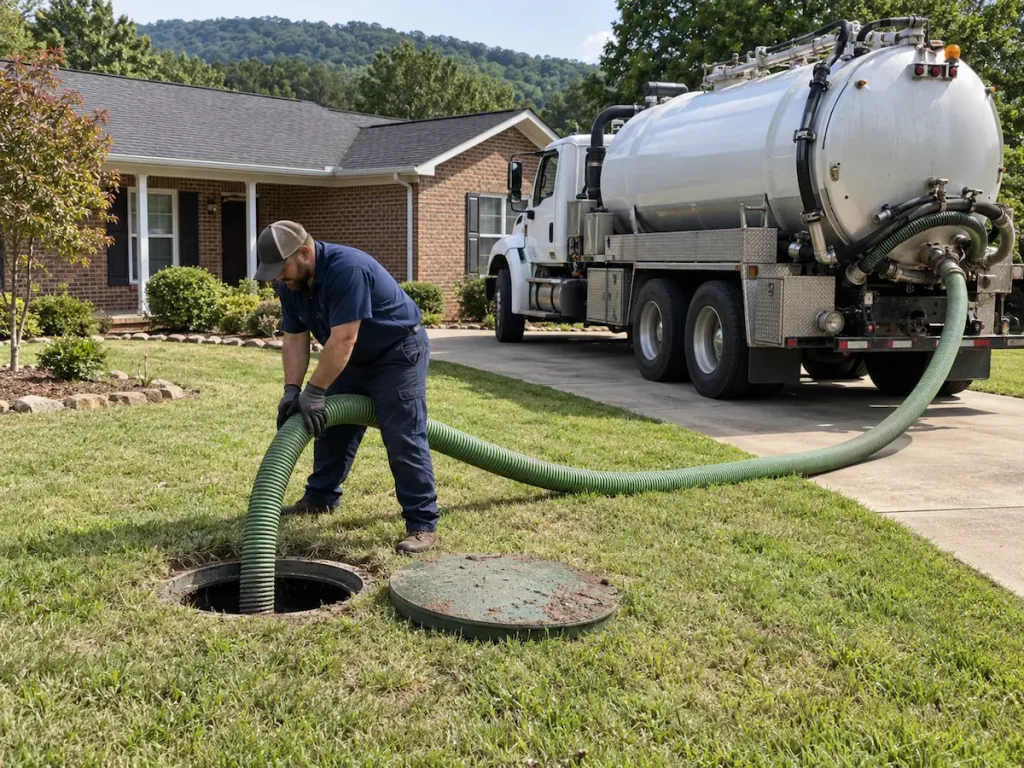
We find your tank, open it up, pump out every bit of sludge and scum, and check the baffles while it’s empty. You get the price before we start and a written note of what we saw when we’re done.
- Open 24/7 for backups
- Price confirmed before we start
- Full pump-out, not a skim
- Lids found and dug out
See what’s building up inside your tank
Every septic tank fills with solids: sludge sinks to the bottom, grease and scum float on top. Once those layers take up about a third of the tank, solids start slipping out toward the drain field. Set your household below and watch the layers.
A rough guide from common sizing rules, not a measurement. The only way to know for sure is to open the tank and measure the layers, which we do on every visit.
What happens during a septic pump-out
A pump-out done right takes about an hour on most homes. Skipping steps is how a tank gets “pumped” and still backs up a month later, so here’s exactly what we do.
- 1
Find and open the tank
We locate the lids, dig them out if they’re buried and open the main access, not just a small inspection port, so the whole tank can be emptied.
- 2
Measure first
We check how thick the sludge and scum layers are and where the liquid sits. Liquid above the outlet tells us something downstream isn’t taking water.
- 3
Pump it all out
The vacuum truck takes the liquid, the floating crust and the packed sludge on the bottom. We break up hardened layers so nothing stays stuck in the corners.
- 4
Check it empty
With the tank empty we look at the inlet and outlet baffles, the walls and the outlet filter if you have one. Filters get rinsed back into the tank.
- 5
Close up, write it down
Lids back on, sod back in place. You get a short note: date, gallons pumped, what we saw and when we’d come back.
Signs your septic tank needs pumping
A full tank rarely fails all at once. It gives you a few weeks of hints first. If you notice two or more of these, call before it turns into a backup.
Every drain is slow
One slow sink is usually a clog. Sinks, tubs and toilets all slow at the same time point to the tank.
Gurgling toilets and drains
Air pushed back up the pipes means water has nowhere to go. You’ll often hear it when the washer drains.
Sewage smell outside
A rotten-egg smell around the lids or over the drain field, especially after a heavy rain.
Soggy ground
Wet, spongy soil or standing water over the tank or field when the rest of the yard is dry.
Greener stripes in the lawn
Grass that’s thicker and greener over the drain field than anywhere else is being fed by effluent.
Water in the lowest drain
Sewage coming up in a downstairs shower or floor drain means the tank is full now. Stop running water and call.
Sewage backing up right now? See our 24/7 emergency septic service.
How much does septic tank pumping cost in Huntsville?
These are the ranges most jobs fall into. We confirm your exact price on the phone or at the tank before any work starts, never after.
| Job | Most jobs run |
|---|---|
| Standard home tank (about 1,000 gallons) | $300–$550 |
| Larger tank (1,250–1,500 gallons) | $400–$700 |
| Buried lid we have to find and dig out | add $75–$300 |
| Inspection on its own, no pumping | $150–$350 |
| Businesses and commercial tanks | quoted on site |
What moves the price
- Tank size. More gallons, more truck time and disposal.
- The lids. Lids at ground level are quick. Lids under a foot of red clay take digging.
- Distance to the truck. Tanks far behind the house or downhill need extra hose.
- Time since the last pump-out. Sludge left for ten years packs hard and takes longer to break up.
- Night and weekend emergencies. We’ll tell you on the phone if after-hours pricing applies.
Septic services in Huntsville and nearby towns
Emergency Septic Service
Sewage backing up, tank alarm sounding or a yard turning to swamp. We answer day and night.
Emergency service →Septic Tank Inspection
Buying or selling a home, or just want to know where your tank stands. We open it, measure it and write it up.
Inspections →Septic Tank Locating
No idea where the tank is? We trace the line from the house and uncover the lids.
Tank locating →Pumping Schedule
How often your tank actually needs it, based on its size and how many people live in the house.
Find your schedule →Commercial Septic & Grease Traps
Septic tanks for shops, churches and farms, grease traps for restaurant and church kitchens. Scheduled around your hours.
Commercial service →Areas We Serve
Huntsville, Madison, Harvest, Meridianville, Hazel Green, New Market, Owens Cross Roads, Gurley and Toney.
Service areas →Septic in Huntsville: what’s different here
In Alabama, a septic system is officially an “onsite sewage system,” and it’s regulated by the Alabama Department of Public Health through your county health department. New systems and repairs need a health department permit. We pump and inspect tanks; if we find something that needs a repair, we show you exactly what we found so you can decide on the next step.
A lot of ground around Huntsville is heavy clay that drains slowly. A drain field in clay has less room for mistakes, so a tank that’s left too long and pushes solids into the field can cost far more than the pump-outs it skipped.
If your home is in one of the outlying areas, like Harvest, Hazel Green, Meridianville, New Market or Toney, and isn’t on city sewer, the tank in your yard is the whole system. Keeping it pumped is the cheapest insurance you have.
Good to know
- Most homes need a pump-out every 3 to 5 years. Big families and small tanks need it sooner.
- When a system is permitted in Alabama, the application includes a plot plan. If you can’t find your tank, the county health department may have that drawing on file.
- Pump before you list a house for sale. Buyers’ inspectors will ask when it was last done.
- Heavy rain doesn’t fill a healthy tank, but it can flood a weak drain field. Backups after storms are worth a call.
How to make your tank last longer
Pumping clears the tank. What goes down the drain decides how fast it fills again.
Do
- Spread laundry over the week instead of five loads on Saturday.
- Fix running toilets and dripping faucets. A running toilet can push hundreds of gallons a day through the tank.
- Keep cars, trailers and heavy equipment off the tank and the drain field.
- Point gutters and sump pump lines away from the field.
Don’t
- Flush wipes, even the ones labeled flushable, paper towels or feminine products.
- Pour grease, paint, solvents or harsh chemicals down the drain.
- Plant trees or big shrubs near the tank or field. Roots find the pipes.
- Count on additives instead of pumping. Solids still build up.
Septic pumping questions we get every week
How often should a septic tank be pumped?
Most homes need a pump-out every 3 to 5 years. A family of five on a 1,000-gallon tank may need it every 2 to 3 years, while one or two people on a bigger tank can often go longer. A garbage disposal adds solids and shortens the time. The surest answer comes from measuring the sludge and scum layers, which we do on every visit.
How much does it cost to pump a septic tank in Huntsville?
Most home pump-outs run $300 to $550 for a standard tank of about 1,000 gallons, and $400 to $700 for 1,250 to 1,500 gallons. Finding and digging out buried lids adds $75 to $300. You get the exact price before we start.
How long does a pump-out take?
About an hour on site for most homes when the lids are easy to reach. Buried lids, a tank far from the driveway or sludge that hasn’t been pumped in many years add time.
Do I need to be home?
Not always. If the lids are accessible and the gate is open, we can do the work and leave our notes. We’ll call before we head out either way.
Do septic additives replace pumping?
No. Solids that don’t break down still settle in the tank whatever you add, and the only way to get them out is to pump them. A healthy tank already has the bacteria it needs.
Will pumping fix a soggy drain field?
Pumping takes the pressure off right away, and if the tank was overfull that can be enough. If the field itself is failing, the water comes back. We’ll tell you what we saw in the tank and at the outlet so you know which one you’re dealing with.
Need your tank pumped?
Call any time, day or night. We’ll give you a price and a time.